

Why Submission Intake Breaks at Renewal Season (and How to Fix It)
Every commercial lines team knows the feeling: the inbox doubles, turnaround slips, and good risks go to faster markets. The fix is not more people. It is a different shape of work.

Every commercial lines operation has a season it dreads. For most it is the January 1 and July 1 renewal peaks, when submission volume can double in a matter of weeks. Turnaround times slip, underwriters spend their days triaging rather than underwriting, and brokers quietly send their best risks to whichever market answers first.
We have spent the last year inside the submission desks of carriers and MGAs of every size. The pattern is remarkably consistent, and so is the fix.
The problem is not volume. It is shape.
When leaders describe renewal season, they talk about volume. But when you watch the work, volume is rarely the real constraint. The constraint is that every submission arrives in a different shape and has to be hammered into the same one before anyone can make a decision.
A typical submission lands as an email with four to twelve attachments: an ACORD 125 and 140, a schedule of values in a spreadsheet nobody has seen before, five years of loss runs from three prior carriers, and a broker narrative that contains the one detail that actually matters. Before an underwriter can look at it, someone has to:
- Read the email and work out which account and line of business it relates to
- Open every attachment and rekey the key fields into the policy admin or workbench system
- Check the risk against appetite and flag anything outside guidelines
- Chase the broker for the missing loss run or the unsigned application
- Route the file to the right underwriter with a summary
None of these steps requires judgment that only an underwriter can provide. Yet in most organisations, they consume between 40 and 60 percent of underwriting capacity during peak periods.
Why adding people does not work
The instinctive response is to throw people at the problem: temps, offshore teams, or underwriters working weekends. This helps at the margins but creates its own costs. New staff take weeks to learn the quirks of each broker's formatting. Quality drops as fatigue sets in. And when the peak passes, you are left with either excess capacity or a burned-out team.
Traditional automation does not fare much better. Template-based extraction tools work well on clean ACORD forms and fail on everything else. Rules engines can route a submission, but only after someone has already done the hard work of reading it.
A different shape of work
The teams that handle renewal season well have changed the shape of the work rather than the size of the team. In practice, that means three things.
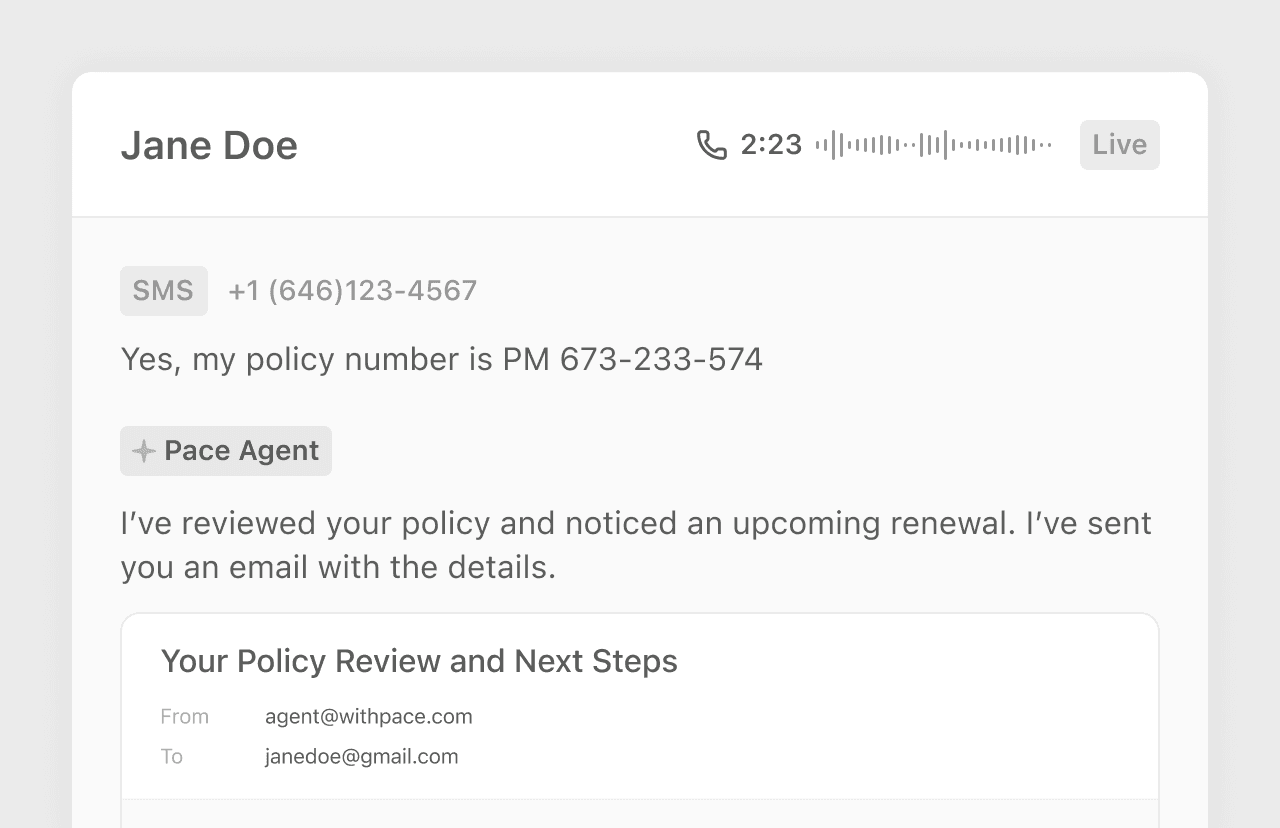
First, intake happens the moment a submission arrives, not when someone gets to it. An agent reads the email and every attachment, identifies the account, extracts the data into your system of record, and assembles a complete file. There is no queue to sit in.
Second, the gaps are chased automatically. If the loss runs only cover three years, or the schedule of values is missing a location, the agent drafts and sends the broker a specific, polite request and tracks the reply. By the time an underwriter sees the file, it is complete or clearly marked as incomplete.
Third, every submission arrives with a recommendation. Appetite fit, a summary of the risk, notable exposures, and a suggested priority. Underwriters spend their time deciding, not sorting.
What changes for the team
When one regional carrier moved its middle-market property desk onto this model last spring, the results were striking. Median time from submission receipt to underwriter review fell from 3.5 days to under four hours. Quote ratios on target-appetite business rose by 22 percent, largely because the team could now respond before competitors. And the desk handled a 70 percent volume spike at renewal without adding a single temporary hire.
Just as important was what did not change. Underwriters still made every decision. Brokers still dealt with the same people. The difference was that those people were finally spending their time on the work they were hired to do.
Where to start
If renewal season is a known pain point, the best time to act is well before it arrives. We recommend starting with a single line of business and a single inbox, measuring time-to-review before and after, and expanding from there. Most teams are in production within six weeks.
If you would like to see how this works on your own submissions, our team is happy to run a pilot on a sample of last year's renewal files. Request a demo and mention renewal season.